
Summary
Location: Lemgo, North Rhine Westphalen, Germany
Geology: Sandy silt
Pollutant(s): Chlorinated ethenes
Reaction: Anaerobic Biodegradion
Reagent(s): Carbon Source: Newman Zone 60E
Application type: Grid application along the sewer
Surface/length: 700 m2
Number of points: 44
Depth interval: 2,0 – 4,0 m-bgl
Dosage: 200 l/m
Context
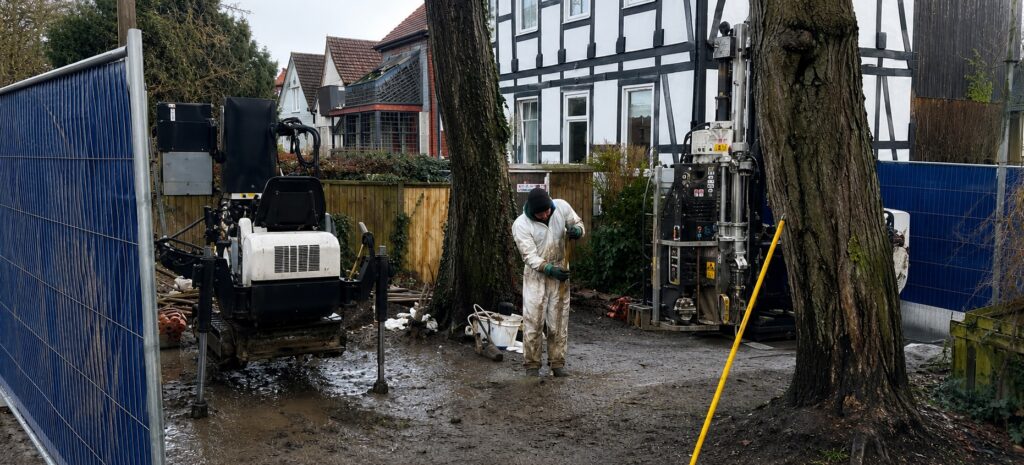
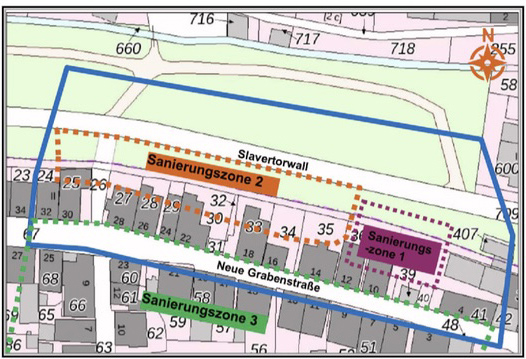
In February 2026, Injectis successfully carried out soil remediation works in a public park in Lemgo (North Rhine-Westphalia). On the site in Lemgo, a soil and groundwater contamination with chlorinated solvents has been detected. The source zone (Sanieringszone 1), located at a former dry-cleaning facility, has yet been excavated and will be treated in the future by other in situ techniques (ISCO).
For the plume zone under the sewer (Sanieringszone 2), the stimulation of reductive dechlorination (ERD) by endogeneous soil bacteria was chosen as the technique to be deployed. Since previous investigations showed that the main pollutant mass remains present in some silt layers, the SPIN® injection technique has been selected for this work.
Reaction and reagents
As discussed with Arcadis Deutschland itself, the intended application is mainly based on RNAS’ Newman Zone 60E product. Newman Zone 60E is an electron donor for enhancing the in situ anaerobic bioremediation of chlorinated solvents. Newman Zone 60E has both fast and slow-release electron donors. Ethanol stimulates microbial growth within hours of injection and rapidly produces
anaerobic conditions in the subsurface. Vegetable oil droplets are retained on soil particles and slowly ferment to hydrogen and volatile fatty acids, which support anaerobic biodegradation for a longer term after injection.
In the course of January 2022, a pilot test has been conducted on one of the parcels of the impacted zone. As could be observed during the injection works, the reagents could be distributed evenly. The reagents arrived in all monitoring wells relatively slowly and at a diluted concentration, without surfacing at the surface or in the monitoring wells. This is a strong indication that the reagents are distributed in the natural porosity of the soil and throughout the entire injected soil trajectory (2 to 4,5 m-bgl). The used dosage varied between 200 and 300 l/m of 5% (m/v) solution.

The graph above shows that the injection of the carbon source had a clear effect on the degradation of the chlorinated ethenes. These positive test results led to a full-scale trial in the spring of 2026.
CSM and Geology
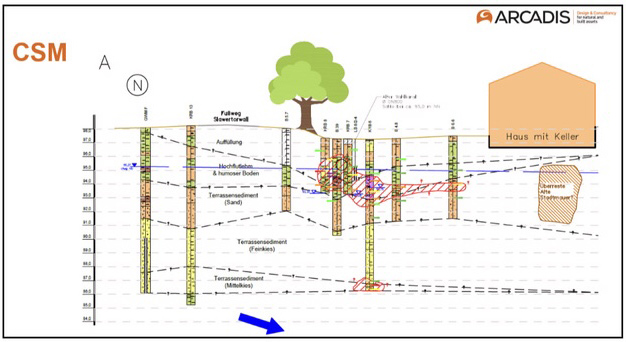
The contamination plume containing chlorinated ethenes is present in the groundwater and soil at a depth of approximately 2 to 3 metres below ground level. The groundwater flows southwards
towards houses, many of which have a basement.
At the investigation site, we find a superimposed layer near the surface that formed the city wall. It consists of silt containing fine-grained sand, clay and humus. It has a varying thickness of 2–3 metres and lies above the water table.
Beneath this lies an natural humus-rich silt layer containing clay. It is within this layer, situated between approximately 2 and 4.50 metres below ground level, that the contamination has spread and remains present. At greater depths, there are more sandy sediments that are less contaminated or uncontaminated.
The contamination entered the soil through leaks in a former sewer that ran alongside the city wall.
To prevent contamination from volatile compounds from spreading further beneath the buildings, a risk-based soil and groundwater remediation is required.
Given that the remediation zone is located in the city park and partly in private gardens, an in-situ approach has been chosen to minimise disruption to local residents and users of the city park.
Particularity
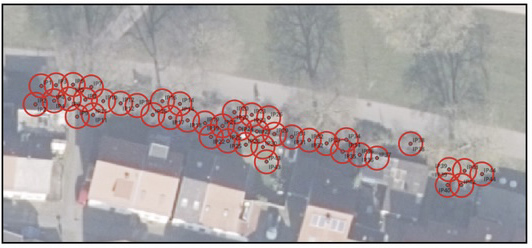
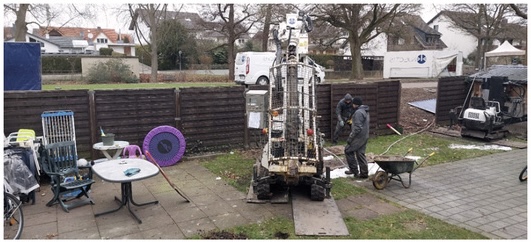
SPIN® injection technology was successfully used to inject an emulsion of RNAS Newman Zone 60 into soil with relatively poor permeability, using 44 injections at depths of between 2.0 and 4.0 metres below ground level. To minimise disruption in the busy city park, two machines were deployed simultaneously.
Given the difficult access to the injection points along the embankment of the city wall and in private gardens, small, easily manoeuvrable drilling machines were used, and for a few injections, the manual Manu-SPIN was employed.
Partly due to the use of these optimal technical resources and a strict schedule, the works were completed within a week.